Fewer Choices, More Power: The Case for Wearing the Same Thing Every Day
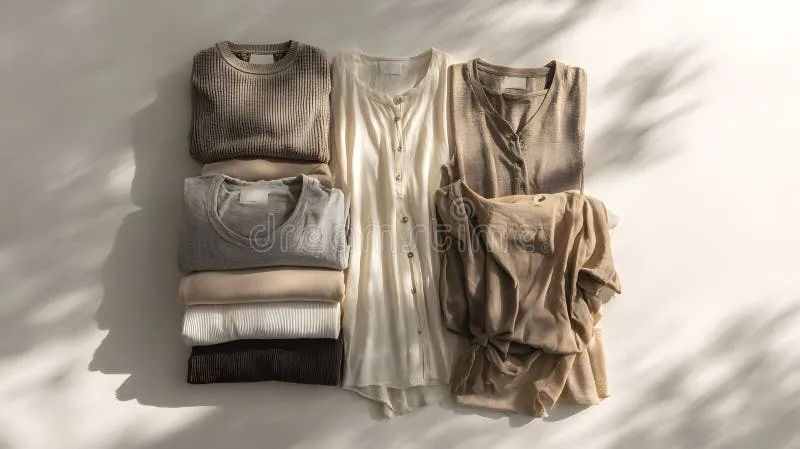
Photo: minimalist professional wardrobe flat lay neutral tones capsule collection, via thumbs.dreamstime.com
There's a moment every morning — usually somewhere between the second alarm and the first cup of coffee — where you stare into your closet and feel absolutely nothing. Not inspired. Not decisive. Just... blank. You've got options. Plenty of them. And somehow, that's the problem.
Now consider this: some of the most effective, high-output people in American business and culture have quietly solved that problem by removing the choice entirely. Same pants. Same shirt. Same shoes. Day after day. Not because they don't care about how they look — but precisely because they do.
This is the uniform effect. And once you understand why it works, you might never look at your morning routine the same way again.
Decision Fatigue Is Real, and It's Costing You
Psychologists have a name for the mental drain that comes from making too many choices: decision fatigue. The research, most famously explored by social psychologist Roy Baumeister, suggests that willpower and decision-making capacity are finite resources. Every choice you make — even a small one — draws from the same cognitive pool.
By the time you've agonized over whether to wear the navy chinos or the charcoal ones, you've already spent capital you could've saved for something that actually matters. A presentation. A negotiation. A creative problem that requires your full attention.
This isn't abstract theory. It's the reason Barack Obama famously limited his wardrobe to gray or blue suits during his presidency. "I'm trying to pare down decisions," he told Vanity Fair. "I don't want to make decisions about what I'm eating or wearing because I have too many other decisions to make."
Steve Jobs had his black turtleneck. Mark Zuckerberg has his gray t-shirt. Satya Nadella, CEO of Microsoft, leans into a consistent palette of understated, well-fitted basics. These aren't coincidences or eccentricities. They're calculated moves by people who understand that mental bandwidth is a competitive advantage.
The Psychology Behind the Repeat
Fashion psychologist Dr. Dawnn Karen — author of Dress Your Best Life — has spoken extensively about the relationship between clothing choices and cognitive load. Her work highlights something counterintuitive: wearing a consistent uniform doesn't dull your sense of self. For many people, it actually sharpens it.
When you stop negotiating with your wardrobe every morning, you free up mental space for self-expression in other arenas — your work, your relationships, your ideas. The uniform becomes a signal, both to yourself and to others, that you've already figured out who you are. You're not auditioning. You're just showing up.
There's also an identity component worth noting. Repeated dress creates what psychologists call a "behavioral anchor" — a consistent external cue that reinforces a consistent internal state. Athletes use pre-game rituals for the same reason. Your outfit can be part of that ritual. A cue that tells your brain: it's time to perform.
But Doesn't That Get Boring?
Here's where the conversation usually stalls. People hear "wear the same thing every day" and immediately picture a sad, deflated version of themselves in a wrinkled t-shirt. That's not what this is.
The uniform effect isn't about monotony. It's about mastery. The goal is to identify a small, curated set of pieces that work so well together — and for your body, your lifestyle, your aesthetic — that you never have to think about them. The thinking already happened. Upfront. Intentionally.
Think of it like a playlist you've built over years. You didn't stop loving music — you just got good enough at knowing your taste that you stopped wasting time on songs that don't fit.
Creative directors at major fashion houses often operate this way. They wear simple, well-constructed pieces not because fashion doesn't matter to them, but because it matters so much that they reserve their aesthetic energy for their actual work. The uniform is the statement.
How to Design Your Own Strategic Uniform
You don't need to go full Steve Jobs to get the benefits. The goal is reduction, not elimination. Here's a practical framework for building a uniform that works for your life:
1. Identify your non-negotiables. What do you actually wear most days? Not what you wish you wore — what you actually reach for. Start there. Those pieces are the foundation of your uniform. They're telling you something about who you are.
2. Nail the fit. A uniform only works if the pieces fit well. This is non-negotiable. A well-fitted basic will always outperform a poorly fitted statement piece. If you're going to wear something repeatedly, it has to be right.
3. Build in a tight color palette. You don't need to wear the same color every day, but staying within a cohesive range — say, navy, white, olive, and camel — means everything works together automatically. No more standing in your closet doing mental math.
4. Invest in quality over quantity. When you're wearing something often, it needs to hold up. This is where cost-per-wear logic kicks in. A $180 Oxford shirt you wear three times a week is a smarter buy than a $40 shirt you wear twice and forget.
5. Allow for one variable. The uniform doesn't have to be a straitjacket. Give yourself one element that can shift — a different jacket, a watch, a pair of shoes. That single variable carries your personality without overwhelming the system.
The Real Flex Is Knowing Yourself
Here's what the uniform effect is really about, underneath all the productivity talk and psychology: it's about having done the work to know who you are and what you stand for. That clarity is rare. And it reads.
When someone walks into a room and they're just... consistent — not flashy, not trying, just settled in their own skin — that's the most compelling thing you can wear. It signals confidence without announcing it. It says, I've already figured this out. Let's get to the good stuff.
At John Steele, that's the energy we're always chasing. Not clothes that perform for other people. Clothes that work for you — quietly, consistently, without drama. The uniform effect isn't a compromise on style. Done right, it might be the purest expression of it.

