Gloriously Unfinished: Why Your Style Quirks Are the Whole Point

Somewhere along the way, we got sold on the idea that personal style is a problem to be solved. A rough draft you keep editing until it's clean, symmetrical, inoffensive. Something to optimize.
But look around at the people who actually command a room — the ones you remember after a party, the ones whose photos you screenshot without really knowing why. They're not the ones who achieved some perfect, algorithmic version of put-together. They're the ones who stopped trying to sand down their edges.
There's a quiet rebellion in that. And it's more powerful than any trend cycle you'll ever follow.
The Optimization Trap
We live in a moment that worships the refined version of everything. Smooth skin, curated feeds, capsule wardrobes with exactly thirty-three pieces that all coordinate flawlessly. The implicit promise is that if you just get it right — if you finally nail the formula — you'll project some kind of authority, some undeniable presence.
Except it doesn't work that way.
When everything is optimized, nothing is interesting. A wardrobe built entirely around "correct" choices ends up looking like a uniform issued by a company you didn't choose to work for. It signals effort without personality. It says: I researched this. What it doesn't say is anything about who you actually are.
And people feel that absence. Maybe they can't name it, but they feel it.
The People Who Refused to Polish
Think about the style figures who've built genuinely unmistakable identities — not the ones who followed the rules perfectly, but the ones who committed hard to something slightly strange.
There's a reason certain musicians, artists, and creatives become style icons not despite their idiosyncrasies but because of them. The guy who wears the same beat-up leather jacket to every event, year after year, until it becomes inseparable from his identity. The woman who mixes vintage Western pieces with sharp tailoring in ways that shouldn't work but absolutely do. The creative director who insists on wearing color in an industry drowning in black, not as a statement exactly, but just because that's genuinely who she is.
None of these people are accidents. But none of them are the result of a style formula either. They're the result of someone paying close attention to what they actually like — and then refusing to apologize for it.
That refusal is the whole thing.
Contradiction Is a Feature, Not a Bug
Here's what the optimization mindset gets wrong: it assumes that consistency means harmony. That a strong personal style is one where everything matches, everything coheres, everything makes logical sense together.
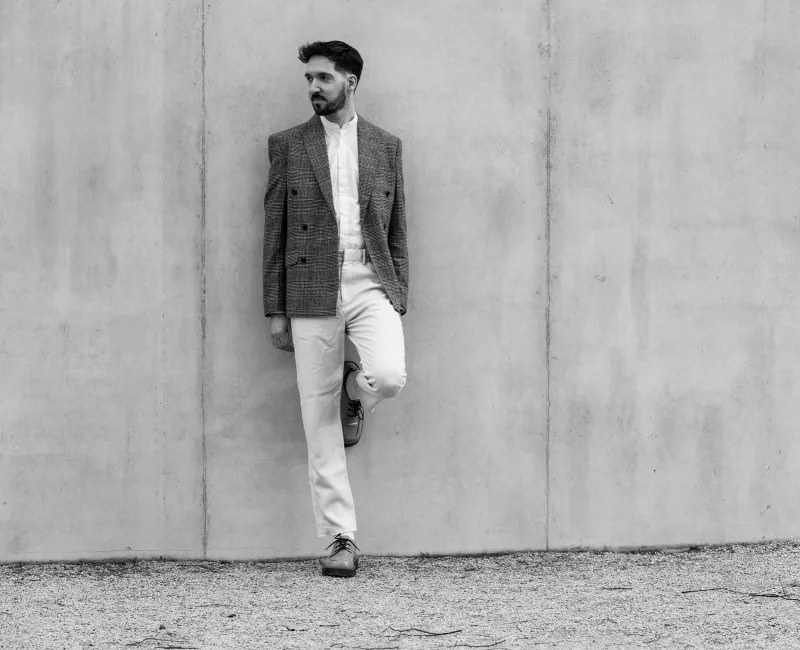
But real identity doesn't work that way. Real people contain contradictions. You can be someone who wears impeccably structured blazers and also has a thing for vintage band tees. You can love clean minimalism in your home and still reach for something with texture and history when you get dressed. These aren't failures of commitment. They're honest.
The most memorable style isn't the kind that looks like it was assembled by a stylist working from a brief. It's the kind that looks like it was assembled by a person — someone with a history, with specific obsessions, with things they care about that don't always fit neatly into a category.
When your wardrobe has that quality — when it reflects a real human being rather than a mood board — people pick up on it. Even if they couldn't articulate why, they trust you more. You feel like someone with a point of view rather than someone auditioning for approval.
Memorable Beats Perfect, Every Time
There's a useful distinction between being remembered and being admired. Admiration is often passive — it's what happens when something looks correct. Being remembered is different. It requires something that snags the attention, something slightly unexpected, something that lodges in the brain.
Perfection, ironically, is forgettable. When every element is exactly right, there's nothing for the eye or the mind to grab onto. Everything slides off. You end up with the style equivalent of a very competent, very forgettable handshake.
Your quirks — the things you've probably been told to dial back, the tendencies that don't fit the current trend — those are what make you stick. They're the friction that creates memory. They're the reason someone across a crowded room thinks there's something about that person without being able to explain it.
Chasing perfection smooths all of that away.
How to Actually Do This
None of this means throwing out the idea of intention. Getting dressed carelessly isn't the same as getting dressed authentically. The goal isn't chaos. The goal is honesty.
Start by noticing what you actually reach for. Not what you think you should reach for, not what looked good on someone else, not what's sitting in your closet because it technically fits and technically goes with things. What do you actually want to wear? What makes you feel like yourself?
Then — and this is the hard part — stop explaining it away. Stop treating your genuine preferences as temporary phases to grow out of or embarrassing quirks to eventually correct. If you've been wearing the same style of boot for fifteen years, that's not a rut. That's a signature. If you have a thing for a particular shade of blue that shows up in half your wardrobe, lean into it. Let it become the thing people associate with you.
And if something in your closet only exists because you thought you should own it — because it's the responsible choice, the versatile choice, the choice that makes sense on paper — ask yourself honestly whether it's ever made you feel like yourself. If the answer is no, it's not serving you. It's just taking up space.
The Real Rebellion
In a world that's relentlessly pushing you toward a more optimized, more palatable, more broadly appealing version of yourself, deciding to just be the specific, slightly contradictory, fully committed version of who you actually are is genuinely radical.
It doesn't require a manifesto. It doesn't require explaining yourself to anyone. It just requires the quiet confidence to stop treating your own instincts as a problem.
The uniform rebellion doesn't look like anything in particular. That's kind of the point. It looks like you — unedited, unoptimized, and completely impossible to replicate.
That's not a flaw in the approach. That's the whole advantage.