Your Closet Is a Portfolio. Here's How to Manage It Like One.
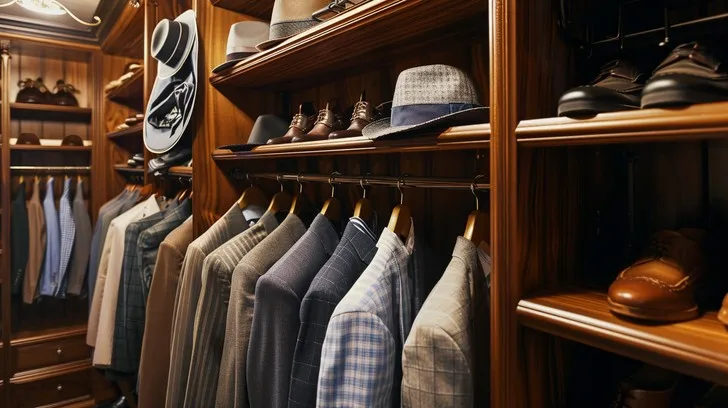
Photo: neatly organized men's wardrobe with quality clothing and accessories on wooden hangers, via images.stockcake.com
Let's talk about money. Not in a preachy, "stop buying lattes" way—in a real, practical way that actually changes how you shop. Because if you've ever spent serious money on something that fell apart in two seasons, or bought something cheap that you wore twice before donating it, you already know the problem. The issue isn't how much you're spending. It's how you're thinking about what you're spending it on.
The best wardrobes aren't built by people with unlimited budgets. They're built by people who treat clothing purchases like financial decisions—with a clear sense of what they're buying, why they're buying it, and what kind of return they expect to get.
The Old "Investment Piece" Narrative Is Broken
For years, the fashion world has been selling us a version of "investment dressing" that basically means: spend more money on fancier brands. But that's not really investing—that's just expensive shopping with better PR.
A real investment piece isn't defined by its price tag. It's defined by its return. And return, in wardrobe terms, comes down to a few measurable things: how many times you'll actually wear it, how long it'll hold up structurally and aesthetically, how well it works with the rest of what you own, and whether it appreciates in visual impact over time rather than dating itself out of rotation.
By that definition, a $400 cashmere crewneck that you wear three times a week for five years is a far better investment than a $1,200 logo-heavy piece that gets dated in eighteen months. The math isn't complicated once you stop thinking in price and start thinking in value.
The Portfolio Framework: Think in Asset Classes
Every serious investment portfolio has a structure—a mix of assets that serve different purposes. Your wardrobe works the same way.
Core Holdings (Your Blue Chips)
These are your high-quality, low-drama basics. A well-constructed white Oxford shirt. A dark-wash denim that fits like it was made for you. A versatile wool trouser in charcoal or navy. A clean leather boot or Derby shoe in a neutral tone. These pieces don't generate excitement, but they generate returns—consistent, reliable, compounding wear over years. Treat them like index funds. Spend real money on them, take care of them, and let them do their job without overthinking it.
What makes a core holding? Materials that age well rather than deteriorate: full-grain leather, tightly woven wool, long-staple cotton. Construction details that hold up: reinforced seams, quality hardware, clean finishing on the inside of the garment (a reliable sign that the maker cared about the whole thing, not just the exterior). And silhouettes that don't date—classic cuts that read as current in 2025 and will still read as current in 2030.
Growth Assets (Your Statement Pieces)
These are the pieces that carry more personality—a structured blazer in an interesting texture, a leather jacket with the right amount of edge, a coat that makes the whole outfit. They're not trend-driven, but they're not invisible either. The key is selectivity. You don't need many of these. Three or four genuinely great statement pieces that work with your core holdings will generate more combinations—and more visual impact—than a closet full of mediocre ones.
When evaluating a growth asset, ask: does this extend my existing wardrobe or does it exist in isolation? A piece that only works with one other thing in your closet has limited upside. A piece that unlocks five new combinations? That's compounding interest.
Speculative Plays (Your Trend Experiments)
Every portfolio has some room for risk—and your wardrobe should too. The difference is knowing what you're doing. Trend-adjacent pieces should be bought cheaply and worn hard, or bought secondhand so the original depreciation has already happened. Don't drop serious money on something that's fundamentally tied to a specific moment in time. Buy the trend at a price that reflects its shelf life.
Materials That Actually Appreciate
Not all fabrics age the same way. Some deteriorate—pilling, fading, losing structure. Others develop character. Understanding the difference is one of the most useful things you can know as a buyer.
Full-grain leather softens and develops a patina that cheaper leathers never achieve. Raw or selvedge denim fades in patterns unique to the person wearing it—creating something genuinely one-of-a-kind over time. Waxed cotton builds a worn-in quality that looks better the more it's used. Heavy wool holds its shape and drape across years of wear. These materials don't just hold up—they evolve, and that evolution adds value.
On the other side: polyester blends pill and lose their hand quickly. Fast-fashion cotton goes thin after a season of washing. Anything with heavy synthetic content tends to look cheaper over time, not better.
The Rotation Strategy
Even great pieces need to be managed. Wearing the same leather jacket every single day will age it faster than rotating it with two or three others. The same logic applies to shoes—cedar shoe trees, rotation between pairs, and occasional conditioning can extend the life of quality footwear by years.
Think of rotation as portfolio rebalancing. You're not abandoning pieces—you're managing them strategically so the whole wardrobe stays in good shape and no single item carries more wear than it should.
The Real Return on Investment
At the end of the day, the best-managed wardrobe isn't the one with the most pieces or the highest price tags. It's the one where almost everything earns its place—where you open your closet and see options, not noise. Where every dollar you spent is still paying dividends in the form of a look you're confident in, every single day.
That's not a fashion goal. That's a financial one. And like most good financial decisions, it starts with thinking clearly before you spend.


