Less Closet, More Clarity: The Surprising Freedom That Comes From Owning Less
Here's something that doesn't make sense until it does: the fewer clothes you own, the more you can actually do with them.
Most of us grew up equating volume with value. More stuff meant more choices. More choices meant more freedom. So we kept buying, kept holding onto things we never wore, kept stuffing shelves and doubling up on hangers — all in the name of having options. And then we'd stand in front of that overstuffed closet every morning, paralyzed, grabbing whatever was cleanest and calling it a day.
That's not abundance. That's clutter wearing a disguise.
The Problem With Too Much
Psychologists have a name for what happens when choices multiply past a certain point: decision fatigue. Your brain treats every decision — even a minor one like what to wear — as a small withdrawal from a finite mental energy account. By the time you've burned through a dozen options at 7 AM, you've already spent resources you needed for something that actually matters.
Barry Schwartz wrote about this in The Paradox of Choice, and the core idea is as relevant to your wardrobe as it is to any other part of life: more options don't make us happier or more capable. They make us anxious, indecisive, and more likely to second-guess whatever we pick.
The closet you've been treating as an asset? It might be the thing slowing you down.
What High Performers Actually Do
Look closely at people who operate at a consistently high level — founders, creatives, athletes, executives — and you'll notice something. A lot of them wear the same things, over and over, on purpose.
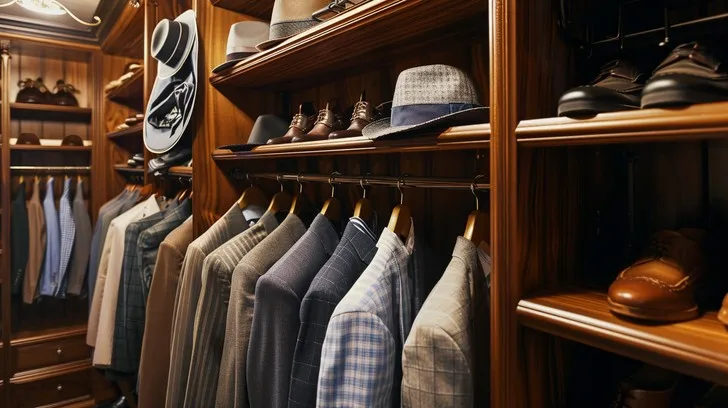
Obama famously narrowed his wardrobe to gray and blue suits to eliminate one more decision from his day. Anna Wintour, who arguably has more fashion access than anyone on the planet, shows up in a nearly identical silhouette season after season. Matilda Kahl, a creative director in New York, adopted a personal uniform — white shirt, black trousers — and wore it every single day for years. She's talked publicly about how much mental space that freed up for actual creative work.
These aren't people who ran out of options. They deliberately created constraint. And that constraint gave them something back: clarity.
Constraint Is a Creative Tool, Not a Limitation
There's a concept in design and music theory that constraint breeds creativity. Give a musician infinite instruments and infinite time, and they often freeze. Give them three chords and a deadline, and they write something real. The same logic applies to personal style.
When everything in your closet genuinely works — when every piece earns its place — you stop wasting energy on elimination and start spending it on expression. You're not asking "does this even fit?" or "why did I buy this?" You're working with a curated toolkit where every item is already a yes.
That's when interesting things start to happen. You notice combinations you'd never tried because the noise is gone. A jacket you'd always worn one way suddenly works three others. Proportions click. Textures talk to each other. The edited wardrobe becomes a creative space rather than a storage problem.
The Edit Is the Work
Here's where most people get stuck: they understand the concept but can't bring themselves to actually remove things. The "I might wear it someday" logic kicks in, and suddenly every item has a hypothetical future that justifies its presence.
But think about it this way. If a piece hasn't made it off the hanger in six months, it's not serving you — it's serving a version of yourself you imagined buying it for. That's a sentimental lease, not a wardrobe strategy.
Editing takes honesty. You have to be willing to look at something you spent money on and admit it doesn't belong anymore. That's uncomfortable. But the alternative is a closet full of small regrets that you navigate around every single morning.
Start with what you actually reach for. Pull those pieces out and look at them together. Notice the patterns — the colors you keep coming back to, the silhouettes that feel right, the fabrics that hold up. That cluster is your real wardrobe. Everything else is backstory.
Quality Fills the Space That Quantity Vacates
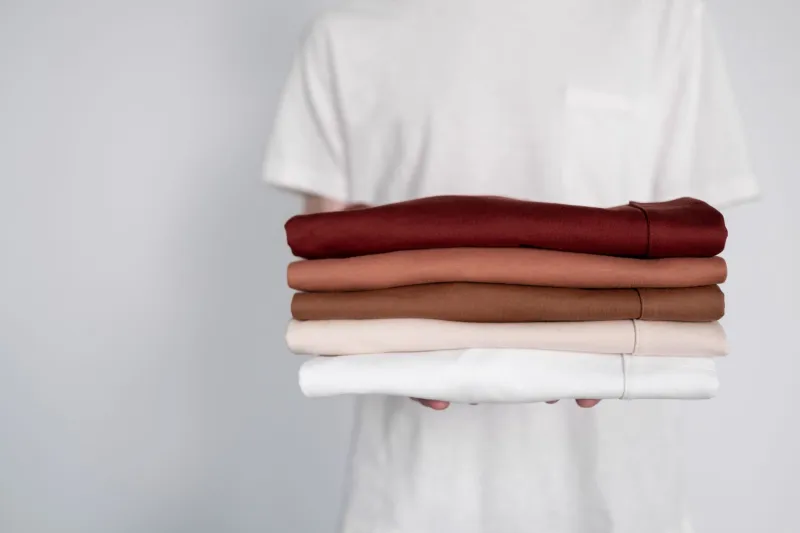
One of the side effects of editing aggressively is that you start to see where the gaps actually are — and they're almost always smaller than you thought. You don't need fifteen shirts. You need five that work in every context you actually live in.
When you're not spreading your budget across a hundred impulse buys, you can invest it in fewer things that are genuinely better. Better construction. Better fit. Better materials. Pieces that look sharper on day one and hold up for years instead of months.
That shift — from quantity-focused to quality-focused — changes how you shop, how you dress, and honestly how you carry yourself. You stop treating getting dressed as a daily problem to solve and start treating it as something you've already figured out.
The Confidence That Comes With It
There's something that happens when you know your wardrobe cold. When you open the closet and every single thing in there is something you'd actually wear — something that fits, something that reflects who you are right now — you stop hesitating. You just get dressed.
That confidence isn't about looking perfect. It's about feeling settled. About knowing that you made deliberate choices and your wardrobe reflects them. There's no clutter to second-guess. No dead weight dragging the whole thing down.
Style, at its best, is intentional. And intention requires editing. Not once, but as an ongoing practice — the same way you'd refine anything else you care about.
Start Smaller Than You Think You Need To
You don't have to blow up your entire wardrobe in a weekend. Start with one category — just your shirts, or just your shoes — and apply one honest question to everything in it: Does this actually work for the life I'm living right now?
Not the life you had three years ago. Not the life you're hoping to have someday. The actual, current, day-to-day life you're living.
Anything that doesn't answer yes gets donated, sold, or set aside. What remains is your foundation. Build from there.
The edited life isn't smaller. It's just more yours.