Your Brain Is Tired Before 9 AM — Here's How Your Wardrobe Is to Blame
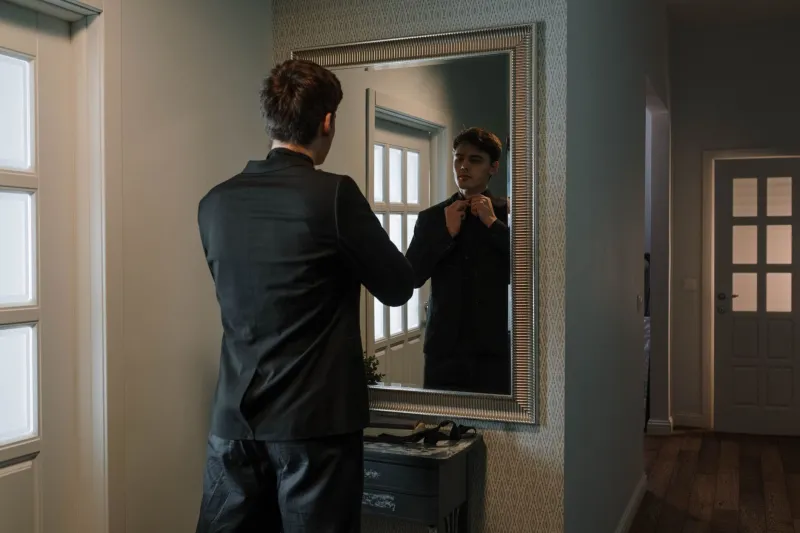
The Decision You Don't Think About Is the One Draining You
It's 7:14 AM. You're standing in front of an open closet, coffee going cold on the counter, and you're already negotiating with yourself. The gray shirt or the navy one? Dress up or keep it casual? Does this jacket still work with these pants?
By the time you walk out the door, you've already burned through a small but real portion of your daily cognitive fuel — and most people never connect those morning micro-decisions to the brain fog that hits around 2 PM, or the reason they snap at someone in a meeting they didn't even want to be in.
This isn't a productivity hack article. This is about understanding something that high-performers figured out a long time ago: what you wear in the morning is a resource management decision.
What Neuroscience Actually Says About Decision Fatigue
The concept of decision fatigue comes out of psychology research that showed human willpower and decision-making capacity operate more like a battery than a muscle — they deplete with use, and the quality of your choices degrades as the day goes on. A famous study tracking Israeli judges found that parole approval rates dropped significantly as the day progressed, rebounding only after meal breaks. The judges weren't becoming crueler. They were just tired of deciding.
Everyday decisions — even the ones that feel trivial — draw from the same cognitive reservoir as your biggest professional calls. Choosing what to wear isn't exempt from that math. In fact, because it happens first thing in the morning, before your brain has fully warmed up, it can feel disproportionately draining.
Researchers have noted that the mental overhead of evaluating options, weighing outcomes, and committing to a choice is largely the same whether you're deciding on a merger strategy or a pair of pants. Scale matters, sure — but frequency matters just as much. And most people make a dozen small wardrobe decisions before they've eaten breakfast.
Why High-Performers Dress Like They're on a Schedule
You've probably heard that Steve Jobs wore the same black turtleneck and jeans every day. Or that Barack Obama limited himself to gray and navy suits during his presidency. Mark Zuckerberg has talked openly about his gray t-shirt rotation. These aren't style failures. They're strategic moves made by people who understood that bandwidth is finite.
Jobs reportedly said he wanted to remove unnecessary decisions from his life so he could focus on what mattered. Obama put it plainly in a Vanity Fair interview: "I'm trying to pare down decisions. I don't want to make decisions about what I'm eating or wearing, because I have too many other decisions to make."
This isn't a billionaire-only strategy. Architects, writers, artists, and entrepreneurs across industries have landed on the same conclusion independently: when you stop treating your wardrobe as a daily puzzle to solve, something shifts. Your mornings get quieter. Your thinking gets clearer. You show up with more of yourself intact.
The Difference Between a Uniform and Giving Up
Here's where a lot of people get it wrong. They hear "wear the same thing every day" and picture beige chinos and a sad polo. That's not a uniform — that's a surrender.
A real style uniform is a deliberate, curated expression of who you are, locked in so you don't have to re-litigate it every morning. It's built around pieces that genuinely fit your body, your life, and your aesthetic. It's repeatable without being robotic.
At John Steele, the whole point is refined individuality — not conformity. A decision-free wardrobe doesn't mean you look like everyone else. It means you've done the hard thinking ahead of time so that every morning, you just execute.
Think of it like a musician who has a pre-show ritual. They're not winging the setlist every night. The preparation happens earlier so the performance can be effortless.
Building Your Own Decision-Free Morning Framework
This doesn't require a complete wardrobe overhaul. It requires intention. Here's a practical way to approach it:
Step 1: Identify your actual lifestyle. Not the life you think you live or wish you lived — the one you actually live. If you're in meetings three days a week and running errands the other two, your uniform should reflect that reality, not some aspirational version of it.
Step 2: Find your anchor pieces. These are the items that reliably make you feel like yourself. The jacket that fits just right. The pants that work in multiple contexts. The shoes you reach for without thinking. These become the spine of your rotation.
Step 3: Narrow your palette. You don't need to go full monochrome, but limiting your color range means everything in your closet works with everything else. Getting dressed stops being a matching exercise and starts being automatic.
Step 4: Build 3–5 complete looks and stop there. Not 30 options. Not a capsule wardrobe with 47 pieces and a spreadsheet. Three to five looks that cover your weekly range. Rotate them. Repeat them. Refine them over time as pieces wear out or your life shifts.
Step 5: Prep the night before. This one sounds small but it's not. Deciding what you're wearing the night before offloads the cognitive work to a time when the stakes are lower. You wake up and the decision is already made. Your morning becomes execution, not deliberation.
What You Get Back
When you stop spending mental energy on your closet every morning, that energy doesn't disappear — it redistributes. People who've made this shift often report feeling sharper in early meetings, more patient in difficult conversations, and less scattered by midday.
There's also something quieter that happens. When your appearance stops being a daily question mark, you carry yourself differently. Confidence isn't just about looking good — it's about not wondering whether you look good. A locked-in uniform eliminates that low-grade static.
You walk out the door decided. And that feeling — of being settled in yourself before the day even starts — is worth more than any outfit you could have agonized over.
The Real Flex Is Knowing Who You Are
Anyone can fill a closet. It takes a different kind of intention to edit one down to exactly what you need and nothing more. The uniform effect isn't about minimalism as a lifestyle philosophy — it's about respecting your own attention enough to stop wasting it on questions that were already answered.
Your style is already there. You just have to stop reopening the debate every morning and let it speak.